
Yes, solar panels can improve a commercial EPC rating, but there’s no fixed number of panels that guarantees a particular grade. The result depends on the building, its services and how the proposed installation is represented in the energy assessment. If reaching a target EPC is part of the reason for buying solar, have an accredited non-domestic energy assessor model the proposal before you commit.
For a business owner or landlord, there are two questions to answer: will the installation help achieve the required rating, and does it make financial sense for the way the premises operate? A good project should address both.
How solar PV can affect a commercial EPC
A non-domestic EPC assesses the building’s energy performance using a carbon-based rating. It considers the building fabric and services, including heating, ventilation and lighting. It isn’t simply a score calculated from last year’s electricity bills.
The government’s guide to non-domestic EPCs explains the assessment process and the use of approved calculation software, such as SBEM or a dynamic simulation model. These methods allow buildings to be compared on a consistent basis.
Solar PV generates electricity, reducing the calculated emissions associated with the building’s energy supply. The SBEM technical manual includes PV generation calculations using installed capacity, orientation, inclination, shading and system performance factors. That’s why an assessor needs the actual proposed layout and specification, rather than just “solar panels included”.
Two buildings with the same size array can receive different rating improvements. Their starting performance, floor area, uses and services may differ. A proposal for one warehouse cannot establish what another warehouse needs to reach the same EPC band.
Ask for a before-and-after assessment before ordering
Start with the current EPC and recommendation report. Ask the assessor to check that the underlying information still reflects the premises. Changes to lighting, heating, insulation or the internal layout may matter, particularly if the certificate predates refurbishment.
Then ask for clearly separated scenarios: the building as it stands today, the proposed solar installation, and any sensible combination of solar with other improvements. Compare the predicted rating, scope and cost of each option. Ask which assumptions still need evidence and whether the target band is only narrowly achieved in the model.
For example, a landlord might be considering solar while also replacing old lighting. The useful comparison is solar alone, lighting alone and both together. This is a decision-making example, not a forecast of points gained or a claim that one measure will always be cheaper.
The solar design must also be buildable. Roof condition, structural capacity, shading, access and the electricity connection can change the feasible array. Our commercial solar design service considers those practical constraints alongside the site’s demand. Share the final feasible design with the assessor before relying on the predicted EPC outcome.
An EPC improvement and lower bills need separate checks
An EPC uses standard assessment assumptions. Your bill depends on your actual working hours, electricity demand, import prices, export arrangements and system performance. An improved rating is therefore not a percentage savings promise.
Ask the solar proposal to show expected annual generation, direct on-site use, exports and any output lost because of connection limits. Generation estimates should allow for the relevant system losses. Where available, a year of half-hourly consumption data helps establish how well solar output overlaps with demand.
An office that closes at weekends needs a different financial assessment from a site with continuous refrigeration. Our guide to commercial solar for businesses closed at weekends explains why unused daytime output and export value matter.
If storage is proposed, ask the assessor how it will be treated in the applicable EPC calculation. Don’t assume adding a battery produces an automatic extra rating improvement. The commercial battery storage business case should separately account for usable capacity, power limits, charging and discharging losses, operating schedules and the export income given up when surplus solar is stored.
Check the letting requirement that applies to your building
As checked on 21 October 2026, the government’s non-domestic landlord guidance sets out the EPC E minimum for privately rented properties covered by the regulations in England and Wales, unless a valid exemption is registered. This applies to continuing lettings as well as new tenancies. Coverage and exemptions need checking for the particular property.
Future policy should be distinguished from that current requirement. In its statement of 18 June 2026, the government proposed EPC B from 2031 for privately rented non-domestic buildings over 1,000m², where cost-effective, subject to secondary legislation. It also said the previously proposed interim EPC C milestone for 2027 would not proceed.
Check the latest rules when making a letting or investment decision. An EPC target written into a lease, funding agreement or company policy may be more demanding than the legal minimum. Scotland and Northern Ireland have separate arrangements.
Keep the evidence needed for the updated certificate
Agree the evidence requirements with your assessor before installation. Keep the final panel schedule, installed capacity, layout, orientation and pitch details, product specifications, commissioning documents and photographs. If equipment or layout changes during delivery, tell the assessor rather than relying on the earlier design.
Installing panels does not automatically rewrite the existing EPC. Arrange for the completed works to be assessed and an updated certificate lodged when you need the new rating recorded. A solar quotation, generation forecast or commissioning certificate is not a replacement for the EPC.
Plan the solar design and EPC assessment together
Send us your site postcode, current EPC and recommendation report, a recent electricity bill and any available interval data. Include roof drawings or photographs, whether you own or lease the premises, and any rating target or deadline.
Sunergy Renewables is based in Nuneaton and works with businesses across Warwickshire, Leicester, Leicestershire and the wider Midlands. Talk to us about a commercial solar proposal that can be reviewed alongside your accredited assessor’s modelling, with the installation scope and savings assumptions made clear.
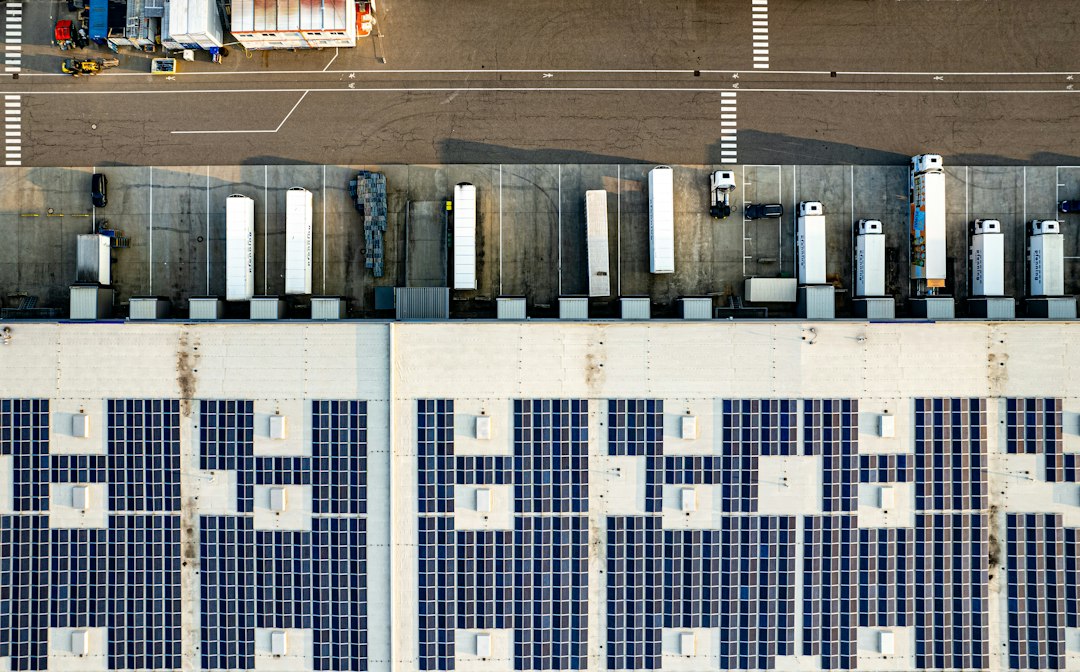
Illustrative stock photograph: rooftop solar panels at a logistics building, by Bernd Dittrich on Unsplash. This is not a Sunergy installation.